

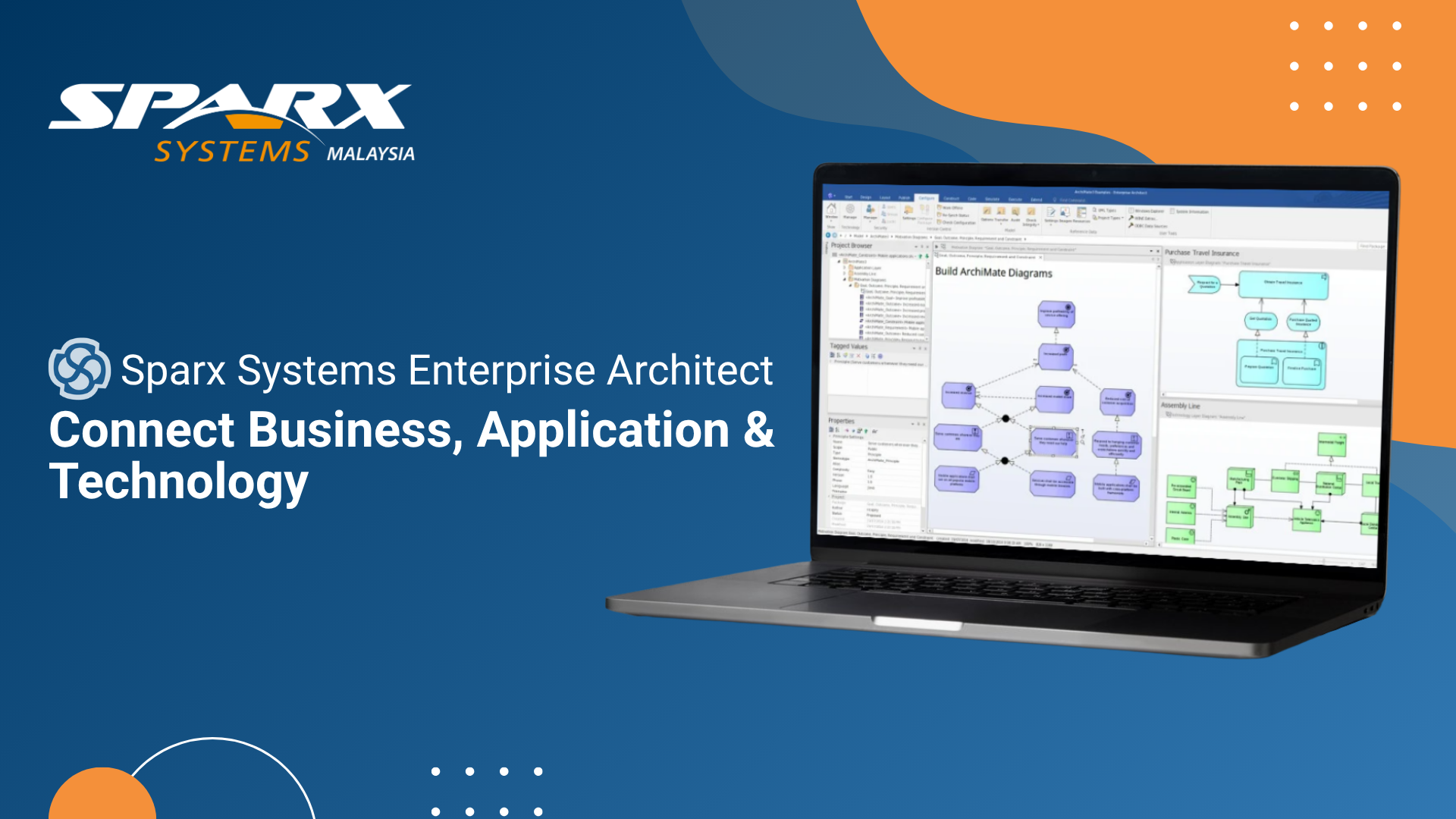
ArchiMate Modeling with Sparx Systems Enterprise Architect (Sparx EA)
Enterprise architecture programs need a language that can describe the whole organization — its business strategy, operational processes, application landscape, and technology infrastructure — in a way that is consistent, interoperable, and understood by all stakeholders. ArchiMate, the open enterprise architecture modeling standard maintained by The Open Group, was designed precisely for this purpose.
Sparx Systems Enterprise Architect supports ArchiMate 3.1 natively, providing architecture teams with a fully standards-compliant modeling environment that integrates ArchiMate models with the full range of Sparx EA's other capabilities.
Explore the Capabilities Behind Sparx EA’s ArchiMate Modeling
Understand how Enterprise Architect supports ArchiMate 3.1 along with integrated modeling across business, application, and technology layers.
ArchiMate 3.1 in Sparx Enterprise Architect
Sparx EA's ArchiMate 3.1 implementation covers the full language specification, including all three main layers — Business, Application, and Technology — as well as the cross-cutting aspects of Motivation, Strategy, and Implementation and Migration. The Motivation aspect allows architecture teams to capture the strategic drivers, goals, requirements, and constraints that shape architecture decisions. The Strategy aspect connects organizational capabilities and value streams to the architecture they depend on. The Implementation and Migration aspect supports the modeling of transformation roadmaps and work packages.
The ArchiMate toolbox in Sparx Enterprise Architect presents elements organized by layer and aspect, with connectors for the standard relationship types including composition, aggregation, assignment, realization, serving, access, influence, triggering, flow, and association. Notation is fully standards-compliant, which means ArchiMate models produced in Sparx EA can be shared with stakeholders using other TOGAF or ArchiMate-aligned tools without loss of meaning.
Modeling Across the Three Architecture Layers
The Business layer in ArchiMate describes the organization from the perspective of its business functions, processes, roles, and services — the things a business does and the organizational structures that do them. In Sparx Enterprise Architect, business layer elements such as business actors, roles, processes, functions, events, services, and objects can be modeled and connected to represent how value is created and delivered. These elements can be linked to BPMN process diagrams within the same repository, creating a consistent view from high-level business function down to detailed process flow.
The Application layer captures the application components and their interactions that support the business layer. Application components, services, functions, interfaces, and data objects describe the application landscape in a technology-agnostic way. The Technology layer then describes the physical and virtual infrastructure — nodes, networks, system software, and technology services — that hosts and connects the application layer. Viewing all three layers together in Sparx EA gives architecture teams a complete picture of the organization's sociotechnical stack and the dependencies that run through it.
Start Building Your Enterprise Architecture Models with Sparx Enterprise Architect
Experience how Enterprise Architect supports real-world ArchiMate modeling, from strategy mapping to impact analysis and governance.
Supporting TOGAF and Enterprise Architecture Frameworks
ArchiMate was designed to complement TOGAF, the most widely used enterprise architecture framework, and Sparx Enterprise Architect supports TOGAF-aligned working through its built-in templates, viewpoints, and model structures. TOGAF viewpoints define standard ways of looking at an architecture from the perspective of different stakeholders — from the capability-focused view of a business sponsor to the infrastructure-focused view of an operations team. ArchiMate models in Sparx EA can be organized to support these viewpoints, producing the artifacts that TOGAF Architecture Development Method (ADM) phases require.
The ability to link ArchiMate models to UML system designs, BPMN process models, and requirements artifacts within the same Sparx EA repository creates an integrated architecture that spans all the ADM phases. Architecture decisions and their rationale can be captured as structured model elements rather than narrative documents, creating a searchable, traceable record of the architecture evolution that governance boards can interrogate and audit.
Change Impact Analysis Across the Enterprise
One of the highest-value capabilities that ArchiMate models in Sparx Enterprise Architect enable is change impact analysis. Because ArchiMate explicitly models the relationships between business processes, applications, and technology infrastructure, it becomes possible to trace the impact of a proposed change through all three layers of the architecture. If a business process changes, which applications are affected? If an application is decommissioned, which business capabilities does it support, and what technology does it run on? These questions, which are often answered through manual research and stakeholder interviews, can be explored directly through the model's relationship network.
Baseline management capabilities in Sparx Enterprise Architect allow architecture teams to snapshot the ArchiMate model at key milestones — before a major transformation program begins, at program stage gates, and after completion. Comparing baselines reveals exactly what changed between states, providing the audit trail that governance and compliance programs require and the retrospective analysis that helps architecture teams improve their transformation planning with Sparx EA.
Scale Enterprise Architecture Across Your Organisation
Enable distributed architecture teams with secure access, shared repositories, and real-time collaboration through the Sparx Cloud Platform.
Communicating Architecture to Stakeholders
ArchiMate models are powerful for architecture professionals but can be challenging for stakeholders without modeling training. Sparx EA's documentation generation capabilities allow teams to produce narrative architecture documents with embedded ArchiMate diagrams for executive-level communication, while the full model detail remains accessible to practitioners in the repository.
For organizations where broader stakeholder access to architecture models is a priority, Sparx Systems Prolaborate provides a web-based interface through which ArchiMate models published from EA can be browsed, discussed, and reviewed without requiring stakeholders to install or learn EA.